It is law within the UK that every item of precious metal sold such as Platinum, Gold, Silver is stamped labelling the item with the type of metal it is. Platinum pieces which weigh less than 0.5 grams, 18ct Gold and Palladium pieces weighing less than 1.0 gram and Silver pieces weighing less than 7.78 grams are except from hallmark.
At Diamonds Factory all our products are hallmarked as per UK hallmarking law from London Assay Office (The GoldSmith Company)
Where Hallmarking Began
The Goldsmiths' Company Assay Office is the oldest assay office in the United Kingdom. It has provided hallmarking services since The Goldsmiths' Company was founded in the 1300s. The company received its royal charter in 1327 and ranks 5th in order of precedence of the 12 Great Livery Companies of the City of London.
Hallmarking dates back to the 1300s when Edward I of England passed a law requiring any item made of silver, which was offered for sale, to be at least of equal quality as that of the coin of the realm (silver currency). The wardens of The Goldsmiths' Company were tasked with visiting workshops in the City of London to assay (test) silver articles. If these articles were found to be below standard they were originally destroyed and the metal forfeited to the King. If they passed, each article received the King's mark of authentication - the mark of a leopard's head. By 1478, there were several hundred workshops and merchants manufacturing silver articles in the City of London. It was not possible for the wardens to visit them all so the merchants were ordered to bring their items to Goldsmiths' Hall for testing and marking and a permanent Assay Office was established in the building. This is the origin of the term hallmark - struck with the King's mark at Goldsmiths' Hall.
In 1544 the Goldsmith's Company adopted the King's mark as their town mark and the mark of the leopard's head is now internationally recognised as the mark of this assay office.
Today
The Goldsmiths's Company Assay Office is still based at Goldsmiths's Hall and remains the oldest company in Britain to be continually trading from the same site. However, it also has two satellite offices; at Greville Street in Hatton Garden in the heart of the London jewelry quarter and within a high security complex near London's Heathrow airport. It now has a new off-site facility within the Dalston-based jewelry manufacturer, Allied Gold. This is the first time in the Assay Office's 700 year history that it has opened permanent hallmarking services on a customer's premises.
In addition to hallmarking, the office has now expanded its range of services to support the jewelry trade and enforcement authorities. It offers a variety of specialist analytical services including nickel, lead & cadmium testing, antique silver dating, non-destructive compositional analysis, plating thickness measurement and a melt and assay service for scrap precious metal carried out in their fully independent on-site laboratory. Other services offered are a jewelry valuation service, laser marking, trading standards assistance, high quality photography and a comprehensive range of training and educational seminars, lectures and specialist events.
Know More







 Unlock private sale access
 Birthday privileges
 Plus a world of exclusives, curated for you.


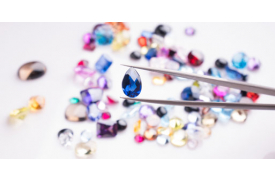
Picking the perfect engagement ring is a significant decision as it will symbolize your love and commitment for your partner for a lifetime. While diamonds are still the top choice for couples, more people are choosing gemstones for their engagement rings. These precious stones offer unique colors and charm that can define a couple’s signature style.
Diamond Side Stone Emerald Shaped Emerald Engagement Ring
$511
Oval Halo Blue Sapphire Engagement Ring
$1,547
Diamond Side Stone Ruby Emerald Engagement Ring
$543
Prong Setting Emerald Halo Engagement Ring
$725
Prong Setting Oval Blue Sapphire Three Stone Ring
$942
Prong Setting Oval Ruby Side Stone Ring
$1,159
The importance of choosing the right gemstone

Just like there are 4Cs for choosing the perfect diamond for an engagement ring, there are a few things to consider when selecting gemstones for an engagement ring.Color: the first step of gemstone selection
The first thing that catches the eye in a gemstone engagement ring for women is the color. These are the three factors in which a gemstone’s color is determined:
When choosing a gemstone engagement ring, you should also consider the significance of the color and what it represents. FHue:
Tone:
Saturation:
Clarity: understanding the gemstone’s purity

Clarity signifies the internal flaws and blemishes of a gemstone — clearer the gemstone, the higher its clarity grade. Although diamonds are known for their pristine clarity, some flaws in a gemstone are preferred. Gemstones are classified according to specific clarity grades.Flawless (FL):
Internally Flawless (IF):
Very, Very Slightly Included (VVS1 and VVS2):
Very Slightly Included (VS1 and VS2):
Slightly Included (SI1 and SI2):
Included (I1, I2, and I3):
Inclusions that can be seen easily.Cut: enhancing the gemstone’s beauty

The cut of a gemstone directly affects how much light it reflects, determining its brilliance. A well-cut gemstone engagement ring will reflect to the light and shine the brightest. The number of cuts also determines the cost of the gemstone. For example, gemstones with more intricate or numerous cuts tend to be more expensive.Faceted cuts:
Cabochon cuts:
Conclusion
When it comes to selecting a gemstone for an engagement ring for women, you want to make sure it matches your preference, style and budget. With a plethora of unique gemstones engagement rings available at Diamonds Factory, you can find the one you want your partner to say yes to. Explore our bespoke range today and get a ring that will be passed down by generations for years to come.